
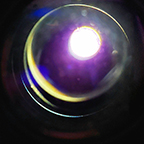
I’m sure many artists will tell you that their finished artwork is only part of the story. This is certainly true for the Fusence collection.
While the pieces may feel abstract and open to interpretation, the process behind them is shaped by the methods used to explore each subject.
I say that Fusence is where art meets science, and this runs through the heart of the creation. This is because many of the methods are not traditionally associated with art, but with scientific observation.
It is through these methods that the work begins to take its form.
Looking Beyond What The Eye Can See
Some of the images I create involve elements of microscopy.
Microscopy is the practice of observing objects at a scale that cannot be seen with the naked eye. It is commonly used in science to examine fine details, structures and patterns that exist beneath the surface of things.
In my work, I use this way of seeing not to analyse or explain, but to explore. By combining a camera with components from a microscope, I am able to move far closer into a subject than usual. What might appear simple at first glance can reveal layers of complexity when viewed at this scale.
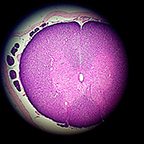
Transforming The Subject
Alongside microscopy, I also work with a DSLR camera using both standard and macro lenses, as well as a microscope eyepiece adapted to the camera.
The macro lens allows focus on very small details, bringing them into sharp clarity. The adapted lens – the microscope eyepiece – alters the way light and focus behave, often introducing distortion, softness or unexpected depth.
Each of these change how the subject is seen. Rather than capturing something as it appears, they allow me to explore how it can be transformed. The equipment does not simply record the image, it actively shapes it.
When something is explored at this level of detail, it often stops looking like itself.
A surface can become a landscape. A fragment can take on a new identity. Patterns, textures and structures begin to dominate, while the original object fades into the background.
This is where the process becomes most interesting.
I am less concerned with what the object is, and more interested in what it becomes. The closer I look, the more the subject begins to shift away from recognition and towards abstraction.
From Observation To Abstraction
Although the starting point is rooted in observation, the final artwork is not about documenting what is seen. This is where the artistic interpretation begins.
The details revealed through microscopy and close observation become the foundation for the image, but they are reinterpreted through composition, colour and light. The result is something that feels both structured and expressive.
This is why many of the finished pieces are difficult to place. There is a sense that they come from something real, but not enough to fully define them. That ambiguity is part of the intention.
Each microscopy piece begins with a title, yet when exhibited it dissolves into its own presence, letting intentions scatter into contours and shadows that resist being named.
A Different Way of Working
Scientific methods are often used to explain and define. In Fusence, they are used to open things up.
They allow me to look beyond the surface, but also to move away from certainty. The process becomes a balance between observation and imagination, where what is discovered is just as important as what is created.
This way of working continues to evolve.
I will be venturing into alternative photographic processes, such as pinhole and cyanotype, where the action of natural light and chemistry conspire to shape the image, turning each photograph into a physical trace of time and transformation. Each method opens new ways of seeing and interpreting what is observed.
Why It Matters
At its heart, this approach is about encouraging people to look again. To notice what might otherwise go unseen, to question what they are looking at and to find something unexpected within something familiar.
If a piece draws you in and makes you pause, even for a moment, then the process has done its job.
If you would like to explore the collection and see how these ideas take shape, you are invited to visit the gallery and discover what stands out to you. If a piece resonates, each artwork is available to bring into your own space.